
By Sally Otis
This year’s AAMI convening took place September 17–18, 2026 in Chicago, hosted by the Art Institute of Chicago and the Museum of Contemporary Art Chicago. Over two days, interpreters and their colleagues dug into everything from labels to exhibition design to what makes a great visitor experience.

From Low Road to High Road: Comfort, Choice, and Confidence Build Lasting Engagement
The convening opened with a keynote from Tedi Asher, Ph.D., neuroscience researcher at the Peabody Essex Museum (PEM): Experimentation as Experience: Harnessing (Neuro)science to Cultivate Connection in Museums. Through vivid illustrations, she showed how our brains engage with art and what that means for gallery design. Asher outlined three questions that shape a visitor’s engagement:
- Self-relevance—How relevant is this to me?
- Schema congruence—How well does this align with my view of myself and the world?
- Assessment—What’s my need and ability to cope with challenges?
She then described two of the brain’s processing paths. The low road is fast, subconscious, and emotional—rooted in the amygdala, built for survival, home to gut reactions and anxiety. The high road is slow and rational, seated in the mPFC, where self-perception, values, and aesthetic understanding take shape.

Asher closed by sharing how PEM uses neuroscience to shape gallery experiences, and uses its galleries as a live lab for neuroscience—describing the Experience Framework as the place where an individual, their environment, and their engagement meet, with impact emerging from that intersection.
Co-creating with Communities: Building interpretation with New and Existing Audiences
Day one’s case studies came from the North Carolina Museum of Art (NCMA), Philadelphia Museum of Art (PMA), University of Michigan Museum of Art (UMMA), and Museum of Fine Arts Boston (MFA Boston)—each co-creating with communities while balancing institutional voice.
NCMA, PMA, and MFA Boston worked with groups that already had ties to their institutions—teens, children, and community advisors—which made building trust and shared goals easier, though not without challenges.
Felicia Knise (NCMA) worked with the museum’s Teen Arts Council over nine months on Ancient Nubia: Excavating Treasures of the Nile, producing audio, a digital guide, programming, and an in-gallery interactive. The teens are invited to the exhibition’s openings and events, and some will mentor next year’s cohort.
Leigh Dale (PMA) created a Junior Interpretation Squad, recording discussions with children to excerpt in kids’ labels—and grappling questions: how much editing turns a child’s voice into an adult’s, and where’s the line between editing and authorship?
Rachel Nicholson and Jordan Cromwell (MFA Boston) worked with the museum’s Table of Voices advisory group while reinstalling the Art of the Americas galleries, asking “What does Boston sound like?” The group gathered ambient sound, spoken word, music, and archival audio, then partnered with Headroom Media on a site-specific immersive audio experience.

Lisa Borgsdorf and Jennifer Friess (UMMA) worked with the Burt Lake Band in Michigan on Future Cache, a Native-led exhibition built around the Band’s history of displacement. The project supported the Band’s federal reaffirmation efforts, produced 30+ public programs (many led by Native partners, some held offsite), and translated labels and audio through a language preservation initiative. Their guiding lesson: a “disposition to yes,” paired with the understanding that a genuinely welcoming space is the work of collaboration.
Prototype, Test, Reflect, Repeat: Refining Interpretation Through Testing
If day one was about who interpretation is made with, day two was about how it gets refined.
Stephanie Foster (Cleveland Museum of Art) built on the success of exhibition family guides to test Little Thinkers, a museum guide for kids and caregivers, which also shaped labels aimed at this same audience for The Renaissance Engraver at Work.

Artwork, installation view, and Little Thinkers label from Cleveland Museum of Art.
Emily Canosa (MFA Houston), new to the museum, navigated a crowded room (7 curators, 4 interpreters, an exhibition manager) to shape interpretation for Frida: The Making of an Icon. The 25-stop audio guide with 8 nested tracks proved that sometimes more is more: about 40% of attendees listened, averaging 12.5 minutes. An interpretive space that got bumped near the gift shop—initially a disappointment—ended up a highly-visible and highly-rated visitor favorite.
Kris Wilton and Jeremy Radtke (RISD Museum) piloted an in-gallery “How to Museum,” using intentionally rough, draft-style paper panels to demystify labels and objects for visitors.
RISD and other museums including Marie Hofer (National Gallery of Art) and Kelly Skeen Fried (National Museum of Wildlife Art) shared how they rethought visitor response spaces beyond writing. RISD invited visitors to sketch inspired by a 300 BCE sculptor’s model. NGA used an analogue pegboard to map visitors’ associations with “home” into a shared community response; and National Museum of Wildlife Art deployed retro rotary phones for visitors to hear—and leave—reflections on the art.
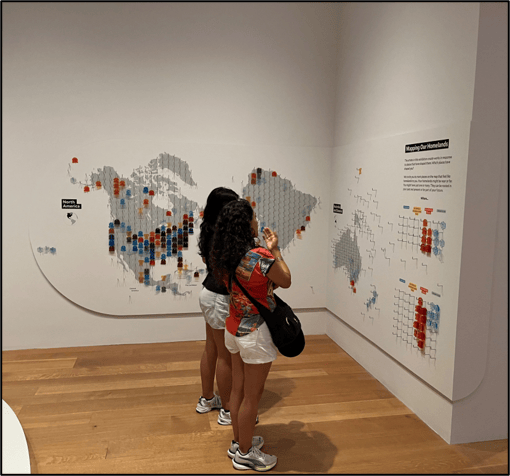

Mapping pegboard and instructions from National Gallery of Art.
More to explore
Both host museums hosted further opportunities for exploration of programming and interpretation. At the Art Institute of Chicago participants rotated through breakout sessions about a Drawing Guide and other interpretive elements for Williem de Kooning Drawing, a Mindful Looking audio guide and public program, and a self-guided 8 Ways to Look at Art brochure. MCA Chicago offered The Poor Farm Experiment performance, a tour of Dancing the Revolution with karaoke, a Patch Up Your Heart activity, a conversation with Antonio Díaz Oliva on translation, and discussion with video producer Sam Clapp on Hear From the Artist videos.
There are far more takeaways from the convening but the throughlines are clear: design with people—not just for them—and treat every label, guide, or response wall as a draft worth revisiting.
We look forward to seeing you next year in Baltimore!

Sally Otis
Sally Otis is the Director of Interpretation and Evaluation at the Nelson-Atkins Museum of Art. She received her Master’s in Art of Teaching from George Washington University’s Museum Education Program and has held positions at several museums and informal educational organizations. She has been a member of the National Association of Interpretation (NAI) since 2018 and earned certifications as a Certified Interpretive Guide (CIG) and a Certified Interpretive Trainer (CIT). As a dedicated museum, interpretation, and arts advocate, she devotes her career to supporting visitor engagement for the betterment of our society. Sally has been an active member of AAMI since 2022 and serves on the Communications Committee.